Siemensstrasse 144
ROM.HOF – Student Residence in Bonn
The city is polycentric. Over time, the surrounding villages have grown into the city body. Even today, the incorporated villages are structurally and spatially perceptible in the city's structure, and sometimes they have retained their centre despite the individual transformation. Towards the outside, the spatial and formal concentration is waning, and the villages maintain their own, overlapping peripheries within the overall urban structure. These are cityscapes of different origins that grow together in a disorderly manner, penetrate each other and, in doing so, create a new void instead of a new centre.
Correspondence of Places
It is a place that linguistically deserves to be described as "between" rather than "in the middle". Its spatial identity is more effectively shaped by the topography of traditional agriculture than by the country roads that run off and the scattered settlements that accompany it. Apart from the direct location of the building, it is difficult to identify a local reference point for the architectural relocation. Rather, it is done indirectly and derived from the dedication. Topologically, the building as a student residential courtyard forms an associative bridge to the neighboring "village" and the university buildings there from the late 19th century near the castle. This spatial relationship cannot be seen from any point in the city. Aesthetically, it is reserved for the "correspondence" (M. Seel) of both places through similarities.
Interior spatial sequences
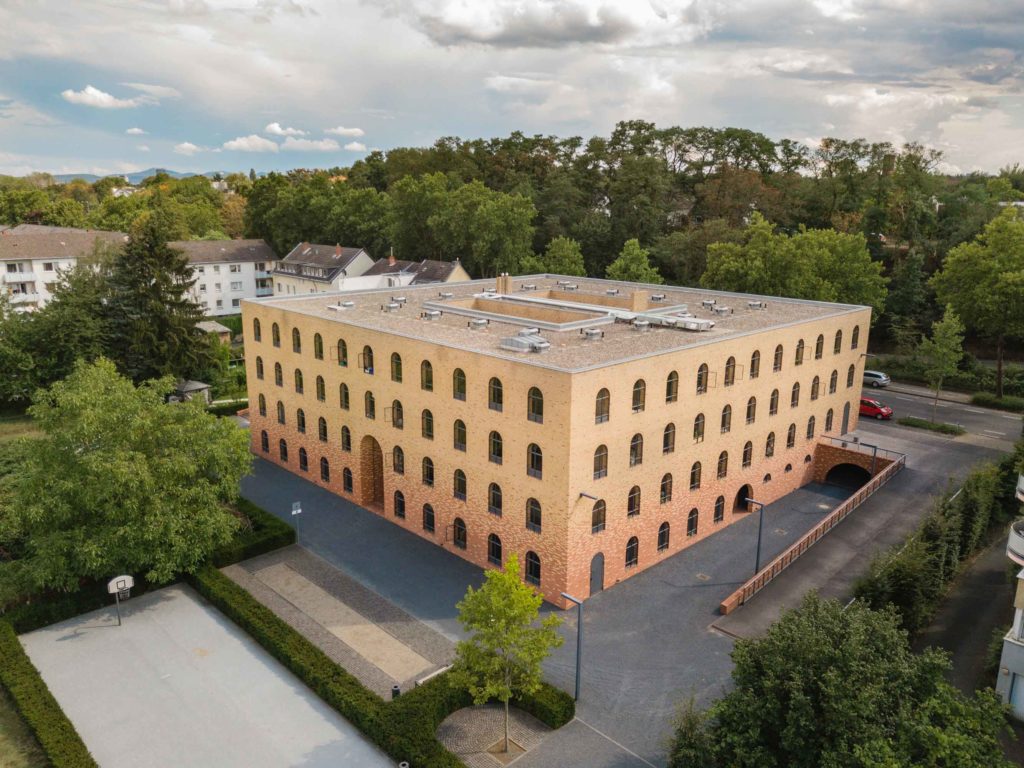
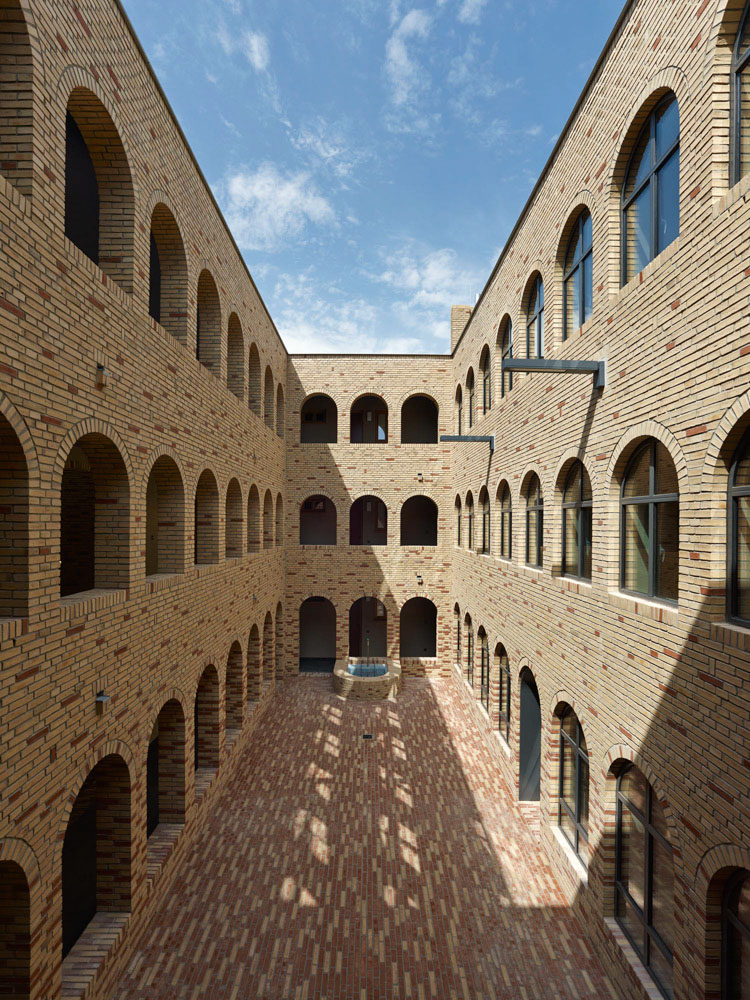
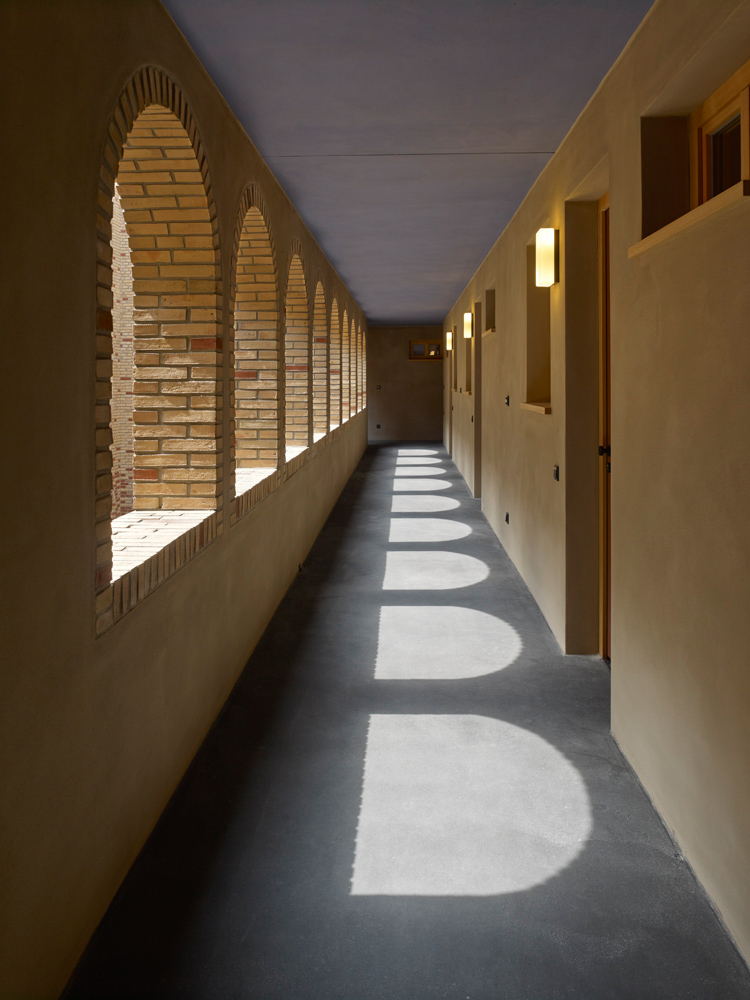
The building's introversion is a response to the site's external space. A gate from the street leads to internal arcades, where small apartments are located. The open corridors of the four floors are connected to one another via stairs in the corners. The core space is divided by a set crossbar ("washhouse") and has courtyards on the upper entrance level and the lower exit level, which are enclosed by arcades and connected to the open landscape via the lower gate. The kitchen is in the lower courtyard, the laundry room is in the upper courtyard, and the playroom above that. The apartments and their annexes, including kitchens and bathrooms, are connected to the arcades via openings with doors and windows. Loggias ("studioli") are in front of the outward-facing rooms.
Loneliness and Togetherness
As a “courtyard”, the building is a tradition that, with its atrium and forum for the house and the city, has a long history of construction. The fact that it is used in both house and urban contexts with different ties is due to a “higher purpose” (G. Semper), which always gives the “courtyard” a type: the dedication to communal living in the house and the city. As an inner external space, the courtyard is the most public part of the building, which reciprocally mediates between the street and the apartment. And just as the courtyard is systematically made up of a core space and adjoining rooms and is dedicated to “community”, the inner interior of the apartment is also based on this very principle. Because of the complementary dedication to “solitude”, however, the “studiolo”, as the core space of the apartment, is eccentrically relocated to the outer periphery of the building. As the end of the space of the apartment, of the house and yard as well as of the city, it is the place of greatest possible retreat from community and society, because of the lack of urban context and the suspended external interior spaces of the city, the "Studiolo" is at the same time the place that is directly confronted with the external outside space of the country and landscapes.
House and Yard as a Festival
The "washhouse" in the middle of the courtyards represents communal living by representing and (hopefully) producing the act of communal living. The residential courtyard as a whole is conceived as a "dense settlement", but the rural is replaced by the urban. As if to compensate for the lack of urban space design on site, this "urbanized settlement" leads to an urbanity inside the building. Only in this way can the horizontally and vertically central and elevated space be appropriately equipped with washing and drying machines, only in this way can the fountain in the courtyard in front of it indicate this dedication. But even more original than the washing, the stove and cooking indicate the communal event. The courtyard, which is open to the landscape on the lower level, is in front of the communal kitchen with its fireplace. And high up, even above the other two, the room is set up for playing. The usual cooking, washing, playing here mean the celebration, a celebration of “beautiful use” (B. Taut), the “celebration” (H.-G. Gadamer) that is and represents community.
system of architecture
The building is organically constructed. Part and whole are in a relationship to one another that is represented as the proportion of rooms and forms and that is based on scale. In the system of architecture, the proportion of rooms leads back to the unity of the opening and the proportion of forms to the unity of the pillar. Opening and pillar, rooms and forms, are from the outset integrated into one and the same modular order of dimensions. Proportion describes the relationship within an order, here of the building, scale describes the relationship between two orders, here, that of the building and there, that of the residents. Only scale puts the building with rooms and forms in relation to something else or others, to the residents. On the surface, it is the craftsmanship of the brick that makes the scale of the building tangible: grasping means understanding. Scale encompasses far more than the traditional anthropomorphism or anthropometry of forms, but rather means, first and foremost, the spatial aspect of architecture, and ultimately it achieves the entire constitution, which also includes the ability of the inhabitants to move, perceive and imagine. A scale, then, that can no longer be exhausted in terms of dimensions, but finds expression in an expanded proportionality.
openness and openings
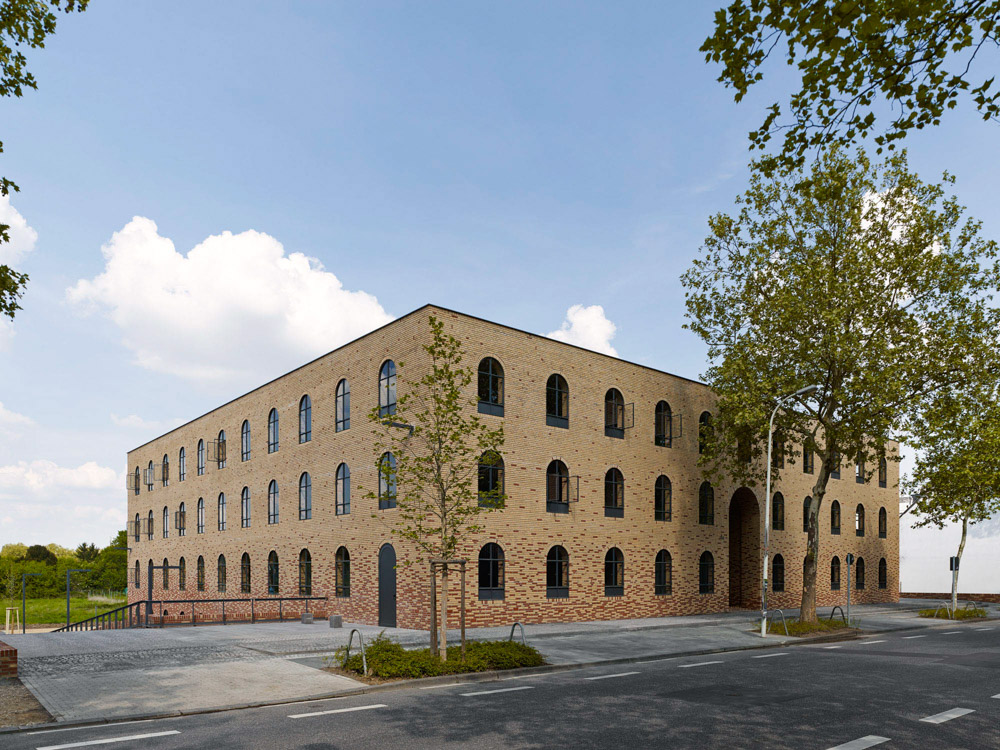
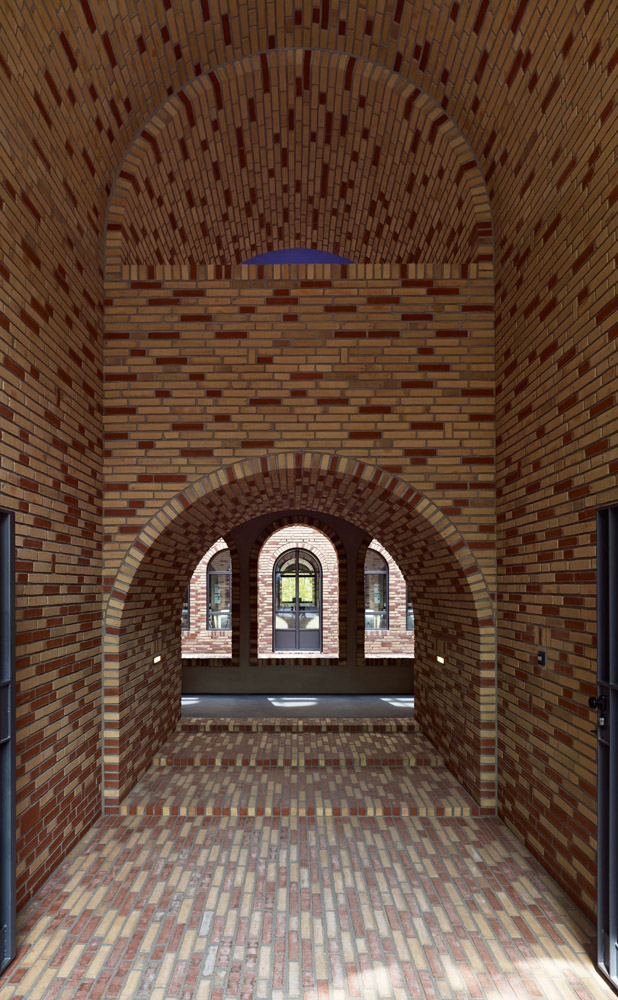
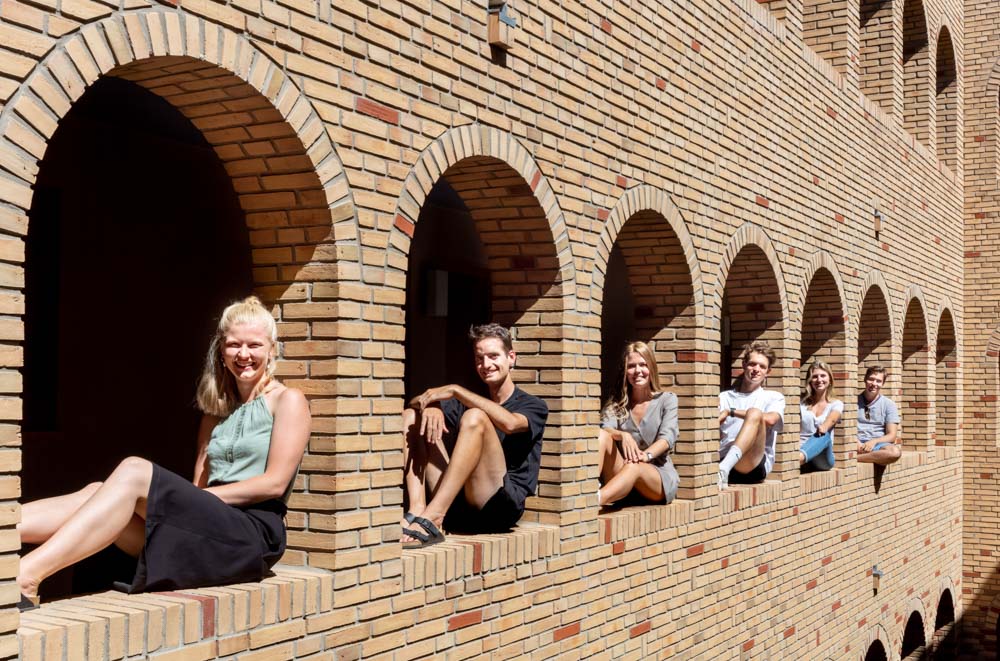
The rooms are borrowed from the walls. They are connected to each other and to the outside space via the element of the opening. The openness and closedness of the walls indicate the social division into public and private. Walls close in and out via openings. The openness of the building decreases from the inside to the outside. In the way that the outer openings of the walls represent the residents' own rooms to the outside, the inner openings, with the doubling of the interval, point to the shared rooms to the inside. The openings are also rooms, rooms inside walls in which one stands and through which one walks. Walls open up as places and paths. Arches and vaults characterize this inner spatiality of the wall in a special way: the protective and sheltering character of the enclosing and at the same time opening gesture has a spatial intensifying effect on those places and paths. An arch focuses the center through which the gaze and movement lead. Unlike the angular opening, which merely cuts out and subtracts the wall, the arch seems to stretch the opening, to pull the wall aside, as it were, and to bundle it in the pillar, which is probably why the mass in the space of the opening still seems to be noticeable.
Botany of the Wall
Especially since it cannot do anything else, at least not without other support, brick is used to build arches and vaults. Openings under arches make walls appear heavy. The loads are smoothly diverted via the arch into the wall and pillars and carried away into the ground. The "flowing away" of the loads allows the wall to take firm root in the ground and grow out of it. This peculiar effectiveness of the wall is symbolically represented in the structure of the stones. As the wall approaches the ground, the water-struck brick changes to red and because of the height difference from the street to the landscape behind, the building forms a base floor at the back that is primarily clad in red. The walls rising above the base turn yellow. The transition from red to yellow shows a progression of increase and decrease that mimetically represents the "growth" of the wall and the "growth" of the building in the mixed transition. This symbolism of the "organic" wall and the organic structure is transformed in several respects and underpinned by the presence of head, stretcher and bearing sides of the stone, by the wild bond, by the branching of the joint network, by projections and recesses and predetermined craftsmanship "errors". The resulting irregular pattern characterizes the growing fabric of the wall and determines the tectonics of the structure - like a plant.
garment of the rooms
The interior polychromy of the walls and ceilings is linked to the material color of the bricks, the red and yellow. Firstly with the third color, the mineral blue, with which the ceilings are "painted away". Three other colors, beige, purple and green, are products of the three main colors. The inner walls of the arcades, stairs and "washhouse" are covered with a cardboard-colored beige as a mixture of red and yellow. Those of the "studioli" facing outwards change from purple to green from bottom to top. If the "studiolo" is behind a wall made primarily of red bricks, the walls are painted in a brownish purple as a mixture of red and blue. Behind the walls made primarily of yellow bricks, green appears as a product of yellow and blue. Due to the silicification with the plastered base, the germ colors show a mineral "depth". The polychromy refers to the public parts, i.e. to the communal spaces of the building, and contributes to their mood. In the external “studioli” of the apartments, the colors symbolically evoke the communal and social aspect and point back to the spatiality of the house as well as the city. Otherwise, the apartments are excluded from the color scheme with white and gray.
Without Color
Detlef Beer's art also omits colour - under the blue ceilings of the "Laundry House" and the "Studioli". This is all the more remarkable when you consider that in Beer's work the use of colour, in particular the colours yellow, blue and red, has fundamental and conceptual meanings: here, however, the architectural presupposition of colour leads to the artistic renunciation of colour. First of all, it is the "omission" of colour that spatialises the intimate relationship between the nude and the building. For in the way in which architecture structurally limits space, but masks the structural element with colour in order to focus entirely on the inner spaces, art, by "omitting" colour, aims first and foremost to open up the spaces, contrary to architecture. But these silhouette-like openings are not intended to draw attention to the construction above, such as the raw plaster or the rough concrete of the ceiling; rather, they are about opening the room into another room, an imaginary room, an expanded, limitless, open space. From there, seemingly from a great distance, prompted by the light background, the motifs left out of the three abstract ceiling paintings radiate back into the inner space. The mathematics of the work and the proper names left out of the ceilings of the "Studioli" mysteriously point to astronomy.
Currently
The building refers to what came before and what has gone before, without distancing itself too clearly from what is “old”. It therefore does not appear to be really “new”. This is not necessarily a disadvantage, as what is still called “new” today may already be called “old” tomorrow – in any case too hastily for the cautious architecture that should not be concerned with fashion anyway. As in the ground, the building also lays foundations in time, a work on the cohesion of past, present and future: the building was probably not modern.
(Explanations by usarch)